TL;DR: Every panel calls itself the cheapest and the best, so stop reading the claims and put the panels side by side. This 2-minute video and the walkthrough below show how the free comparison table on smm.guide lines up to ten panels on the figures that can be measured: the year the domain went online, the lowest public price per 1,000, the order counter and how fast it moves, ratings from named review platforms, and whether the owner has claimed the listing. The best figure in every row is marked, and the link you copy opens the same table for anyone.
Watch it first, two minutes
- 0:00 Ten panels, one table
- 0:22 Adding panels
- 0:38 Reading the table
- 1:02 Reorder and sort
- 1:14 Prices by network
- 1:33 Save and share
- 1:46 From the catalog
- 1:55 Ready sets
- 2:03 Try it
Why a panel's own words decide nothing
Open five SMM panels in five tabs and you will read the same five sentences. Best quality. Cheapest prices. Instant start. 24/7 support. Trusted by thousands. None of it can be checked, and all of it is written by the same person who sets the prices.
What can be checked is narrow, and that is exactly why it is useful. A domain has a registration date. A price list has numbers in it. A public order counter has a value now and a different value tomorrow. A review sits on a platform with a name. Everything else is marketing.
The comparison table on smm.guide is built from that narrow set and nothing else. It holds up to ten panels at a time, one column each, and it marks the best figure in every row so you can see the shape of the answer before you read a single cell. On 19 September 2026 the catalog behind it held 11,820 panels and about 1.8 million services across 63 networks, with 514 panels showing a public order counter that is re-read around the clock.
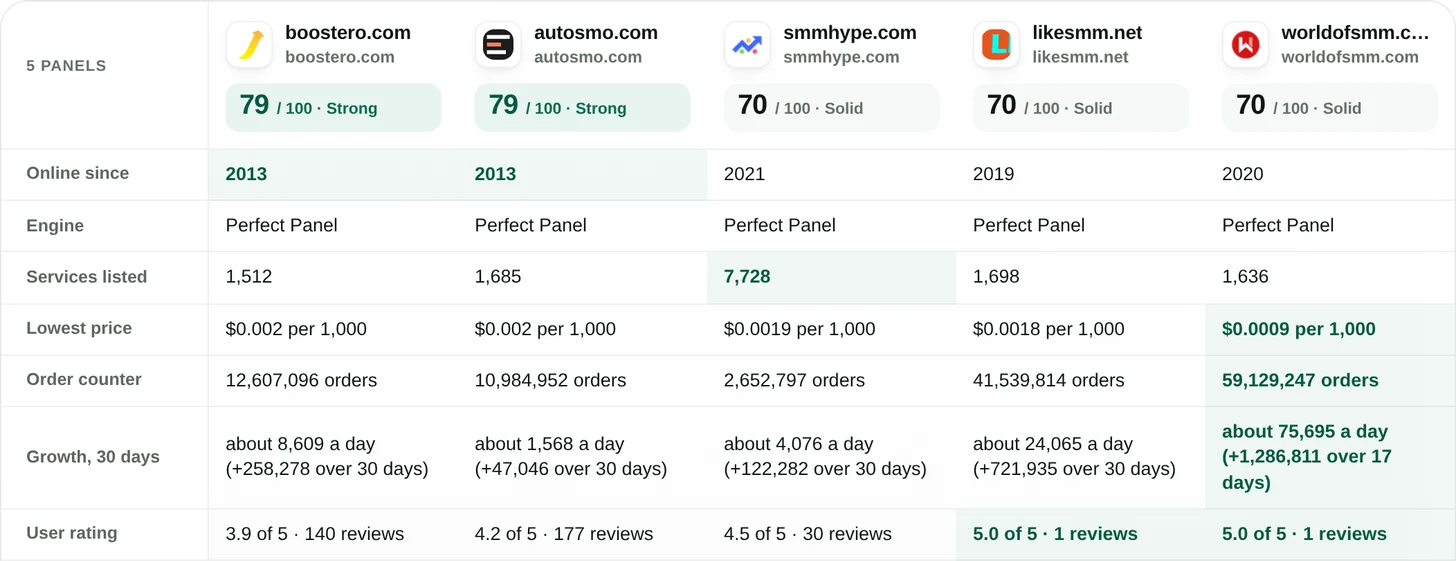
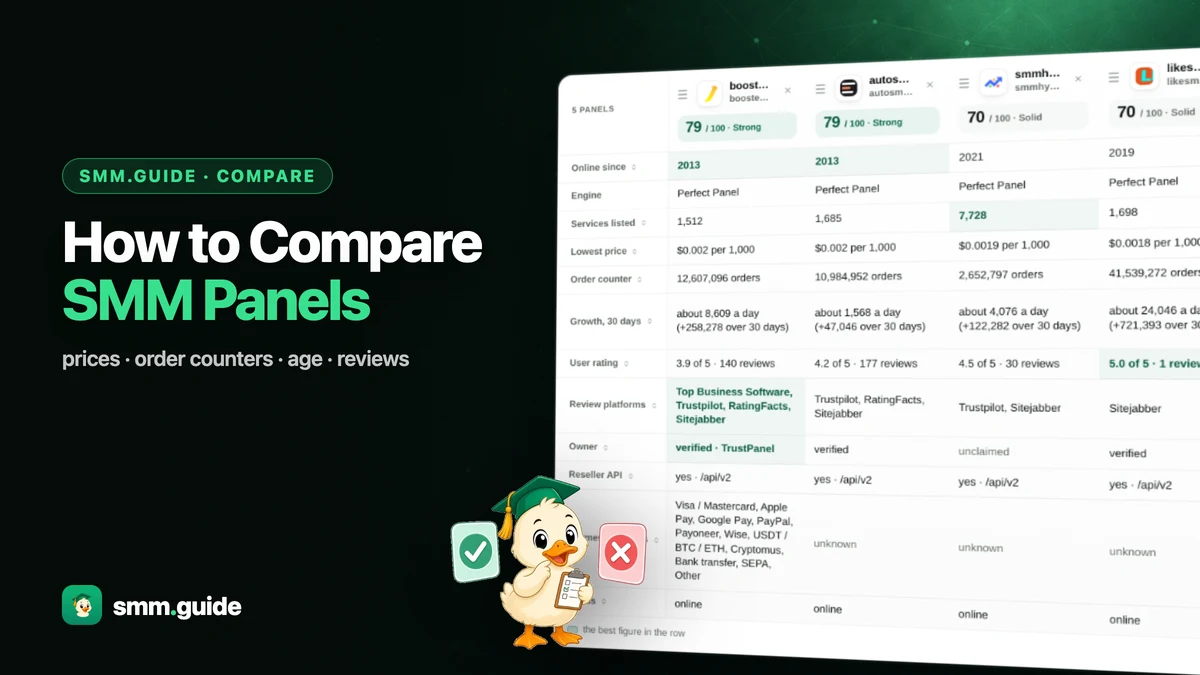
Five panels from the video, read on 19 September 2026. The tinted cell in each row is the best figure of that row, and nothing is tinted when every panel is level or the figure is missing.
The rows, and what each one is worth
Ten rows sounds like a lot until you know what each one tells you. Here is the whole table in plain words, in the order it appears.
- Trust Score
- One number out of 100, sitting under each panel's name, built from longevity, openness and reputation. The formula is published in full and applies to every listing the same way. Above 75 reads as Strong, from 58 as Solid, from 42 as Fair. It is a summary, not a verdict: two panels on 70 can be 70 for completely different reasons.
- Online since
- The year the domain first went live, taken from the registry record or the web archive. The single strongest signal in the table. A panel that has been paying for the same domain since 2013 has a business to lose; a panel that appeared four months ago has nothing.
- Engine
- The software the panel runs on, recognised from the page itself: Perfect Panel, SocPanel and a handful of others. It tells you what the account area will look like, which payment methods are likely, and whether a reseller API is there by default.
- Services listed
- How many services the public price list holds. A panel that keeps the list behind a login says so in this row, and that alone is worth knowing before you register.
- Lowest price
- The cheapest rate per 1,000 anywhere on that panel's list. Useful as a floor, not as a comparison: the cheapest thing on one panel may be Twitter views and on another Telegram views. The price table further down is where prices are really compared.
- Order counter
- The panel's own public counter of completed orders, read on a rolling cycle so every tracked panel is refreshed within the hour. It is the one figure a panel cannot inflate cheaply, because moving it costs real deliveries.
- Growth, 30 days
- How much that counter climbed over the last month, shown as a daily average. This is the row that separates a living panel from a museum. A counter of 12 million that adds 8,600 a day is a business; the same 12 million standing still is a screenshot.
- User rating
- The average and the number of reviews behind it. Read the count, not the stars: 5.0 from one review is noise, 3.9 from 140 reviews is information.
- Review platforms
- Which named platforms those reviews were found on, such as Trustpilot, Sitejabber, RatingFacts or Top Business Software. A rating that exists in four places is harder to arrange than a rating that exists in one.
- Owner, API, payments, status
- Whether the owner has claimed the listing on smm.guide, whether the reseller API is available, which payment methods the panel publishes, and whether the site answered the last check. Small rows, but an unclaimed listing next to a verified one is a difference worth a second of thought.
Nothing in the table is for sale. Sponsored placements exist on the site and are always labelled as such. They never touch a Trust Score, a rating or a highlighted cell, and no panel can pay to look better in a comparison.
Five panels, read on one day
The five panels in the video are ordinary listings from the catalog, picked because they sit close on the score and sell similar things. This is what the table said about them on 19 September 2026. The figures move daily, which is the point of the tool, so treat this as a snapshot and open the live version next to it.
| Panel | Online since | Lowest price | Order counter | Growth a day | User rating | Owner |
|---|---|---|---|---|---|---|
| boostero.com | 2013 | $0.002 | 12,607,096 | about 8,609 | 3.9 of 5, 140 reviews | verified |
| autosmo.com | 2013 | $0.002 | 10,984,952 | about 1,568 | 4.2 of 5, 177 reviews | verified |
| smmhype.com | 2021 | $0.0019 | 2,652,797 | about 4,076 | 4.5 of 5, 30 reviews | unclaimed |
| likesmm.net | 2019 | $0.0018 | 41,539,814 | about 24,065 | 5.0 of 5, 1 review | verified |
| worldofsmm.com | 2020 | $0.0009 | 59,129,247 | about 75,695 | 5.0 of 5, 1 review | verified |
Seven measures, four different leaders. The two panels from 2013 lead on age and on the Trust Score, and both carry three figure digits of reviews behind their ratings. The youngest of the five lists by far the most services. One panel leads on the counter, on growth and on the cheapest prices at the same time, and still has exactly one review, which is precisely the kind of gap a table makes visible and a sales page never will.
That is the useful outcome. Not a winner, but a short list of trade-offs you can decide on: age against price, reviews against volume, a claimed listing against an unclaimed one. Open these five live and the numbers will already have moved.
Prices, where they can actually be compared
A single "lowest price" says almost nothing, because panels are cheap on different things. Below the main table sits a second one, built only from services that at least two of the panels on screen actually sell, at each panel's lowest public rate per 1,000. Pick a network from the chips and the caption above the table recounts who is cheapest on exactly those rows.
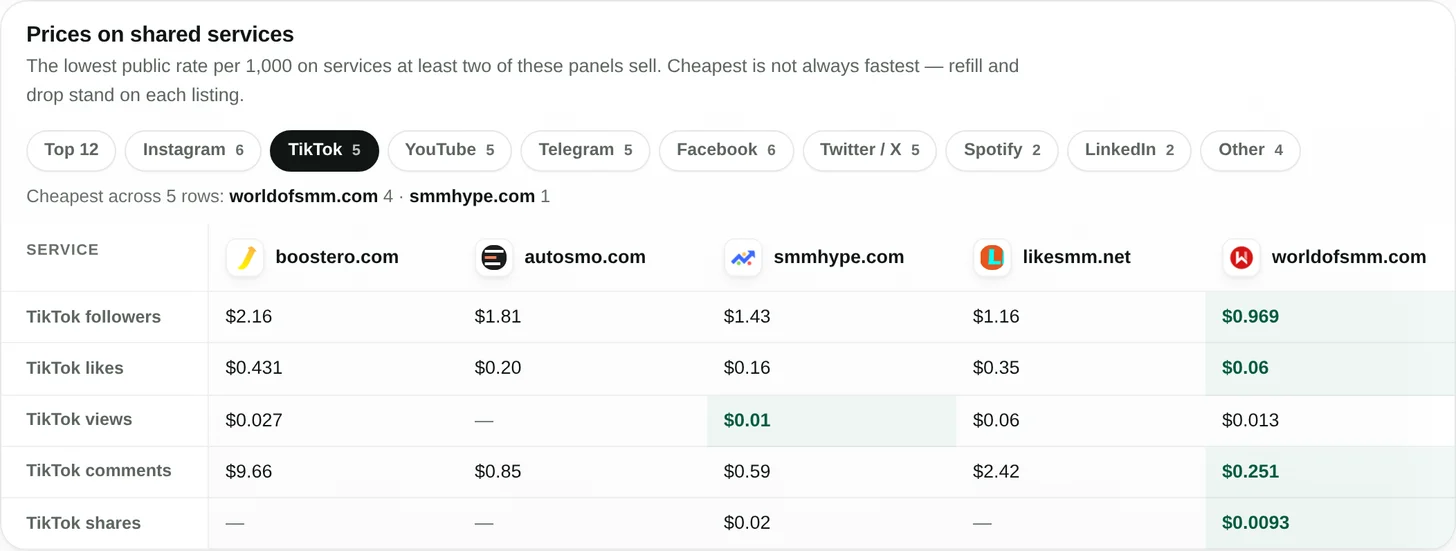
The same five panels, TikTok only. Five shared services, and the cheapest cell changes hands twice: TikTok views go to one panel, the other four rows to another.
On that day, TikTok followers ran from $0.969 to $2.16 per 1,000 across these five, TikTok likes from $0.06 to $0.431, TikTok comments from $0.251 to $9.66. The spread on comments is close to forty times. Nobody discovers that by reading five price lists in five tabs, and nobody needs to.
One warning that belongs next to every price: cheapest is not best. A rate far below what everyone else charges usually buys a different product, one that drops in a week. Use the price table to find the honest middle of the market and to spot the outliers in both directions, then check refill and drop terms on the listing before you order.
Order the columns by whatever you are deciding on
Click the label of any row and the columns reorder themselves by that row, cheapest first, biggest counter first, oldest first. Click it again and the order flips. Turn on "hide rows where all agree" and every row the panels are identical on disappears, leaving only the differences. On five Perfect Panel installations that alone removes two rows of noise.
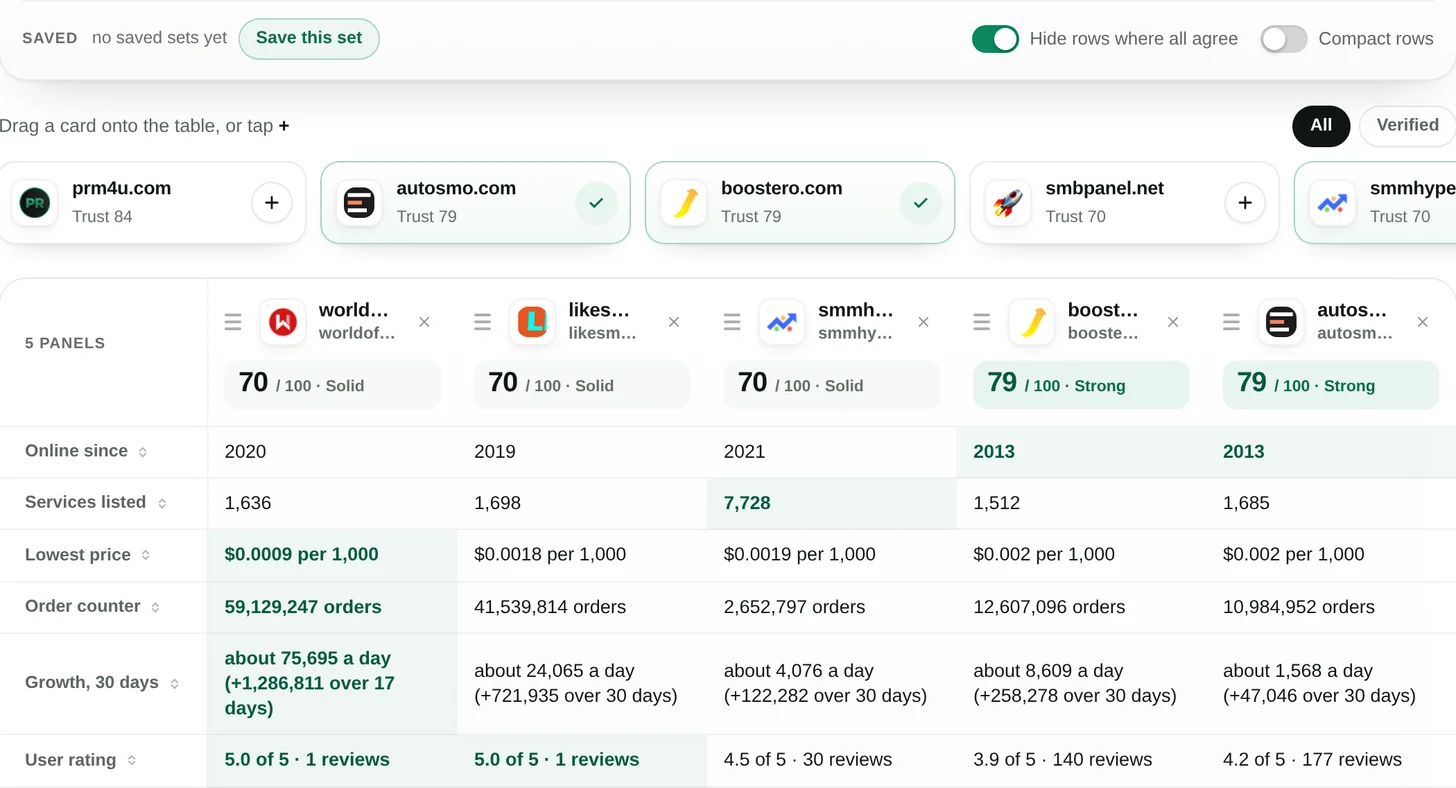
The same five panels ordered by lowest price, with the rows they all agree on hidden. Columns can also be dragged by the grip in their header, so the two you care about end up next to each other.
Building your own table
Four ways in, and they all feed the same table:
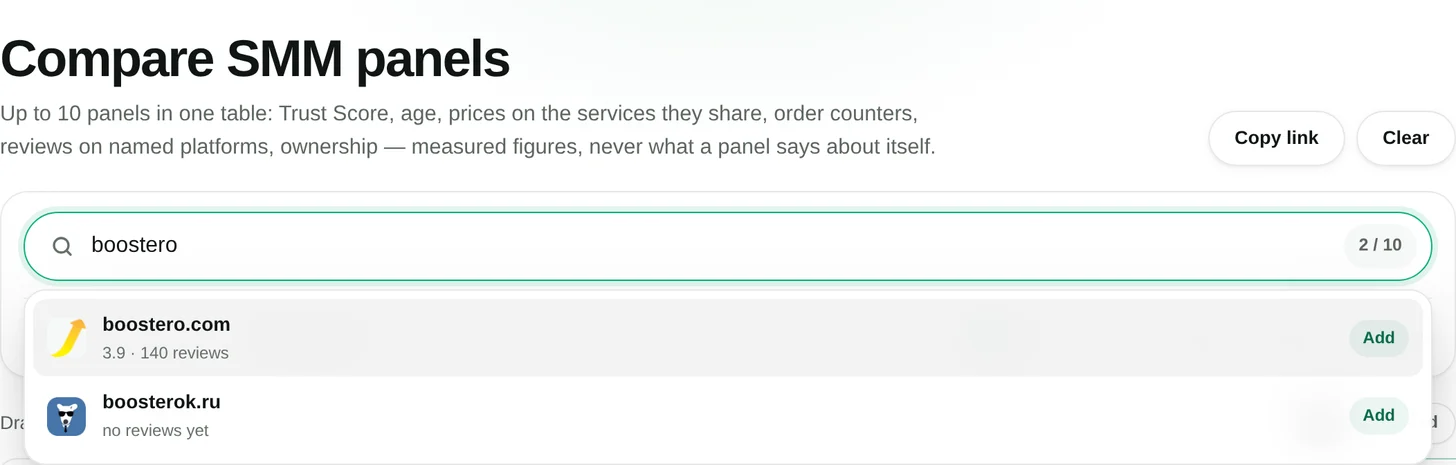
Adding a panel by name. The counter on the right shows how many of the ten places are taken.
Save it, send it, come back to it
A comparison is worth keeping. Save a set under a name and it waits for you in this browser the next time you open the page, up to a dozen sets. Copy the link and the whole table travels with it: whoever opens it sees the same columns in the same order, signed in or not, because the address itself carries the panels.
Guests can read any comparison somebody sends them and open any of the ready sets. Building your own, dragging columns, sorting and saving are the parts a free account unlocks, and the account takes a minute.
Ready comparisons, when you have no time to pick
If you do not want to choose the contenders yourself, six ready sets sit under the table and rebuild themselves every hour: the five strongest listings by Trust Score, the fastest growing over 30 days, the biggest public counters, the cheapest Instagram followers, the cheapest TikTok views, and the five that have been online the longest. The rule that picked each set is printed on its card, so nothing has to be taken on faith.
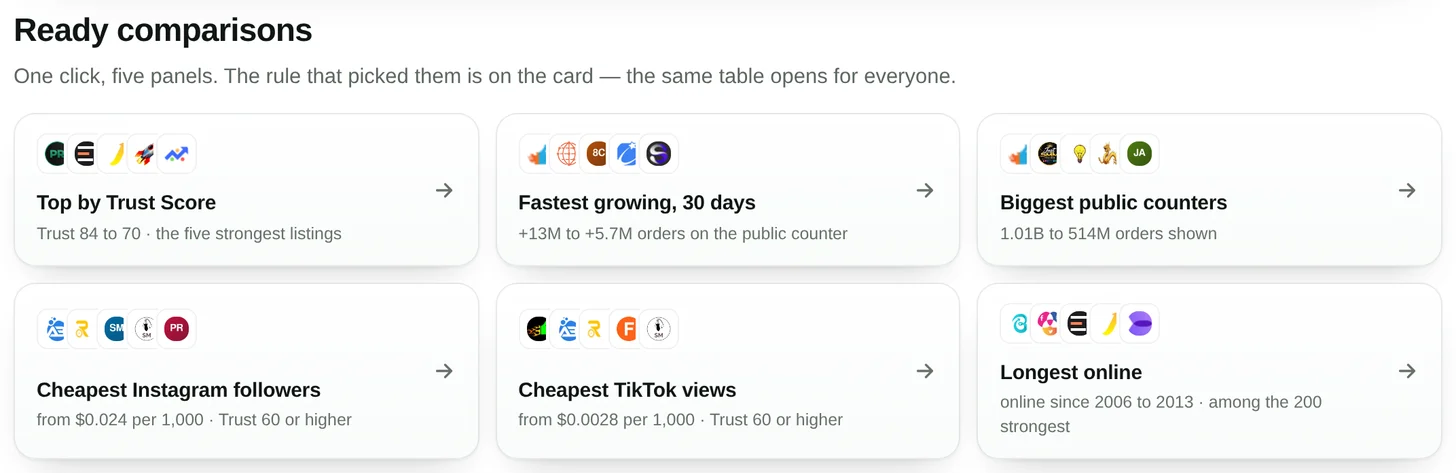
Ready comparisons on 19 September 2026. The cheapest Instagram followers among panels scoring 60 or higher started at $0.024 per 1,000; the longest-running of the 200 strongest listings has been online since 2006.
There is also a ready page for every strong panel against the panels nearest to it on the score, 521 of them at the moment, linked at the foot of the comparison page. Handy when you already know one name and want to see who it is usually weighed against.
Five ways people get a comparison wrong
1. Reading the stars and skipping the count
A 5.0 built on one review sorts above a 4.2 built on 177 in any naive ranking, and means far less. The table prints the count beside the average for exactly this reason.
2. Treating the biggest counter as the best panel
A counter is a volume figure, not a quality figure. Read it together with growth: a huge number that has not moved in a month is a panel living off its past.
3. Chasing the lowest number on the list
The cheapest offer on a service is sometimes a genuinely lean supplier and sometimes a bot farm that drops in five days. If one price sits far below the other four, ask what it buys before you celebrate.
4. Comparing panels that do not sell the same thing
Two panels can look close on the summary rows and share almost nothing in their price lists. The shared-services table is the honest test, and it also shows how thin the overlap is.
5. Deciding without a test order
No table, score or review replaces the smallest order the panel allows. Watch three things: how fast it starts, how it delivers, and whether the count still holds a week later. Two dollars spent that way beats any rating.
A short checklist before you spend
- Age
- Years online, not months. Two panels at the same price and one of them is from 2013: that is not a hard choice.
- Movement
- A counter that climbed this month. Growth beats size.
- Reviews with a source
- Enough of them, on platforms you can name, and read the negative ones first.
- Openness
- A public price list, a visible counter, a claimed listing. Hiding all three is a decision the panel made about you.
- Your own service
- Compare the exact service you intend to buy, not the panel's cheapest headline.
- A small first order
- Always. Then the table has done its job and your own eyes finish it.
Start here
Pick two panels you were already thinking about and put them side by side: the comparison table is free, needs no card and works on a phone. From there, the services explorer finds the cheapest rate for one exact service across every tracked panel, the live monitor shows the counters moving in real time, and the Top 50 by real orders is the same data ranked for a month. If you would rather start from the rules than from the table, the five rules for choosing a panel take three minutes.
And if you run a panel yourself, claim your listing: verification is free, it lets you keep the listing details right and reply to reviews, and an unclaimed column in somebody's comparison is a column that answers for itself.